
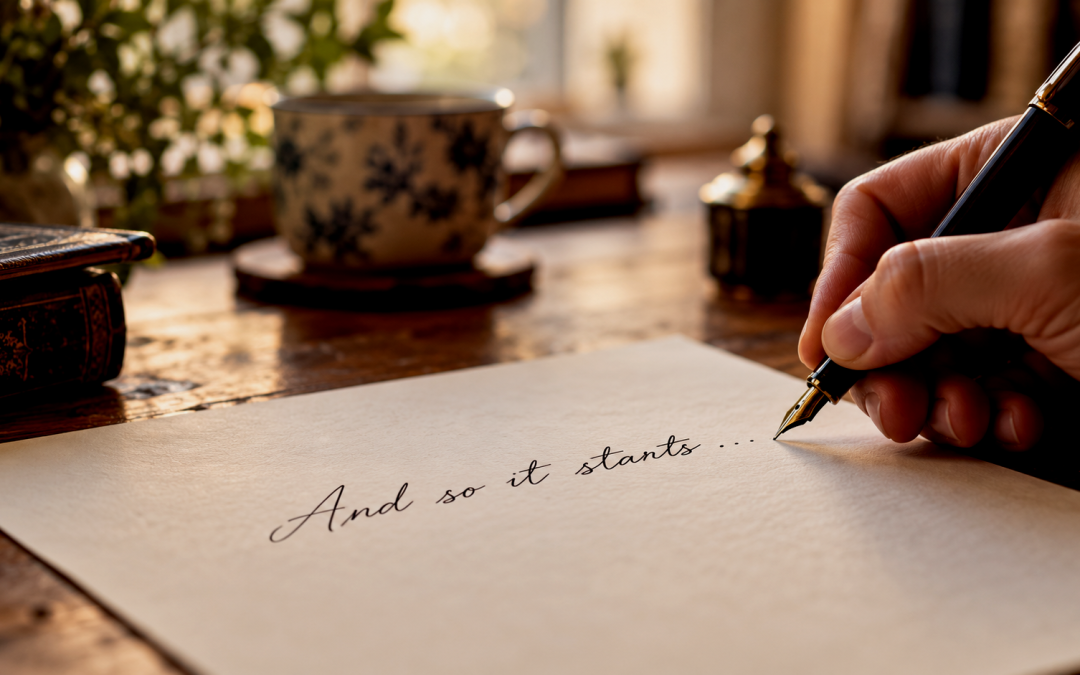
Here I am, doing it again. And once again, it is painfully difficult, especially at the beginning. The fear of getting it wrong is standing directly behind me, narrowing its eyes at my words, one heavy hand resting on my shoulder. Still, it has to be done. So I have to do it.
I have to write.
What is this thing, writing, anyway? What does it mean to me? I want to look around me for a while, and then inward, and see what I may discover. Writing: making marks on or into a surface so that they can be seen by others, taken in and, if all goes well, understood. But I am getting ahead of myself. I ought to start at the beginning, if only to preserve some semblance of order. It is complicated enough already.
The History of Writing
People have been writing for thousands of years. Scholars speak of five to six thousand years, although precursors to writing are probably older still. Who first made marks somewhere in the world and transferred them onto a material capable of preserving them beyond the moment remains obscure. What seems certain is that this happened in several parts of the world at remarkably similar points in human history. Perhaps what we now call writing emerged in communities that had grown so large that information could no longer, or perhaps should no longer, be passed on orally to everyone.
Nor do we know with any certainty what the earliest documents contained. Administration, myths and stories, poetry: ancient fragments offer traces of all of these. What they seem to have had in common was the desire to prevent something from being lost. Information was to be ordered, preserved and remembered, according to need. In Mesopotamia, administrative records were demonstrably written in Sumerian cuneiform. Egyptian hieroglyphs in the burial chambers of the pyramids still proclaim the power and splendour of their owners.
Chinese writing can look back on a history of some four thousand years; its oldest surviving traces are inscriptions carved into oracle bones and tortoise shells. The South American Inca system of knotted cords known as quipu can no longer be read by anyone. Its knowledge disappeared with those who had used it, when invaders carried their violent dreams of gold and infectious diseases into that part of the world.
Writing in this way demanded effort and resources. The ability to read and write was therefore initially available to only a small number of people. How widely literacy could spread depended, among other things, on what people had to write with and on. In Egypt, where papyrus and reed pens could be obtained comparatively cheaply, literacy was far more widespread than in medieval Europe, with its oak-gall inks and precious parchment. When paper, much cheaper to produce, began its triumphant journey westward from China, the number of people using the written word grew with it. The invention of printing made written works easier to distribute and own. Modern e-books do not even ask for space on a shelf.
Today, many people write on computers and no longer need paper at all. And yet pen and paper remain remarkably popular. Why do we not simply write and archive everything digitally by now, or even store it as audio? That would require even less effort than typing. We would merely have to chatter into our smartphones. And yet the written word still seems to possess a particular value. Where does that value come from?
The Value of the Written Word
Writing takes effort. Especially when the result is meant to be good — worth reading. Someone has to surrender a portion of their lifetime and actually compose something. Most human beings are lazy creatures, and I do not mean that reproachfully. Human laziness has given rise to a great many useful inventions designed to make life easier. At this point, heartfelt thanks are due to the inventors of the washing machine and the dishwasher. Part of the value of the written word lies in our recognition of that effort. Someone sat down and did it. Well done!
The written word is powerful. The people in Asia who painstakingly carved intricate symbols into bone and tortoiseshell for use in divination had a purpose. They gave their energy and concentration to discovering something about the nature of things and the shape of the future — or perhaps even to influencing both. Their intention endowed the written signs with power. They were magical. Today, we tend either to smile indulgently at magic or to surrender ourselves to it with great conviction. Whatever one’s position, one fact remains: every piece of writing is magical in its own way.
Lines and shapes on a surface can be transformed into language that carries meaning. They can plant thoughts inside human minds — thoughts that may possess the power to alter the future. Is that not still astonishing? Words can stir emotions capable of moving people to their very depths. The Greek tragedians understood the power of the pain and grief they aroused. Their aim was catharsis: a cleansing of the soul through witnessing and sharing in suffering. The “heroes” of tragedy, often blameless or powerless, marked by fate in cruel and terrible ways, were human beings too. In the Greek theatre, people suffered with them. And when someone looked at the person sitting beside them, they saw the same sorrow reflected in another pair of eyes and knew themselves united in the experience of being human. For a moment, the loneliness that accompanies our separated consciousnesses had been overcome
The written word also outlives the human lifespan. We have a long tradition of preserving in writing those things and circumstances considered worth keeping, those that must not be allowed to disappear. Sumerian temple administrators carefully kept records of their affairs. Many of the world’s major religions base their central teachings on “holy books” or collections of sacred writings. Rulers, whether individuals or institutions, demonstrate and document their power and influence through written laws. Our respect for written messages has even taken on something approaching cosmic foresight. In 1977, The Sounds of Earth were inscribed on the Voyager Golden Records, accompanied by instructions in symbolic language intended to explain to extraterrestrial sophonts – by which I mean intelligent extraterrestrial life forms – how the disc might be decoded.
The written word is also easier to examine, more reliable and, in a rather appealing way, generally more accessible. Once someone has committed themselves to writing, it becomes considerably harder to talk their way out of it later, however considerable their charm. Lists help prevent important things from being forgotten or overlooked. This applies equally to grocery shopping and to collecting evidence for a court case. “What you have in black and white, you can safely take home with you,” my mathematics teacher used to say. And he was right. The transmission of knowledge depends upon writing, particularly theoretical knowledge. What humanity knows has long since become too extensive and too complicated for any one person to remember every detail from every field and pass it on. The age of the universal scholar is long past. How useful written records become when our memory grows a little hazy — or when we simply want to learn something new.
The Value of Writing
It is not only what has been written that has value. The act of writing itself has value too. Anyone who writes with even a modest degree of regularity knows the clarifying, cleansing power of putting things down on paper. Morning pages, for instance, can help clear the mind. The insatiable chatterbox inside one’s head finally quietens down, having been allowed to say its piece properly. Things that trouble us but cannot be changed may stop endlessly circling through our thoughts once they have been captured on a page. And suddenly there is room again: for new thoughts, for creativity, for a different approach to a problem. In that sense, what has been written helps the writing itself. Diaries can offer reassurance and clarity about who we are. I should speak explicitly for myself here: even the things I really ought to know about myself, I appear to forget with astonishing regularity. This is particularly true of painful insights. Then I leaf back through an old notebook and discover that I have written the whole thing down before. So I sigh, metaphorically take myself by the nose, and hope that this time the lesson might stay with me a little longer. Keeping a gratitude journal can have an effect all its own — I am almost tempted to call it therapeutic. Change the standpoint from which you look at the world, and the manner in which you look at it, and many things genuinely begin to appear quite different.
Writing non-fiction is far less dry than it may seem at first. After all, an author is writing about something they have spent a long time thinking about and studying deeply. Every field of knowledge becomes more fascinating the better one understands it and the further one ventures into it. Learning enough to move beyond the blissful stage of half-knowledge can, admittedly, be something of an ordeal.[1] The inner critic will tirelessly ensure that doubts about one’s own abilities remain in excellent health. And yet there is great pleasure in sharing knowledge — in helping someone else take their first steps across unfamiliar ground without immediately tripping over their own feet. Ideally, the writer of non-fiction writes as though explaining something to a friend: trying to make “the thing”, whatever that thing may be, easier for someone they care about. When this succeeds, the writer has written about a subject they know well and value, for someone towards whom they feel goodwill. That is a promising arrangement for enthusiasm and pleasure on both sides.
Anyone who has ever written an academic paper knows how much the process can sharpen one’s thinking. The demands of thorough, properly documented research broaden the horizon. The requirement that an argument be traceable and comprehensible improves both reasoning and language. It can also bring a certain kind of thinking back down to earth, particularly when that thinking concerns matters with only a tenuous connection to everyday life. And yes, by the time I used the word sophonts, it may already have become apparent that I am referring here to my own guild of philosophers. I shall add an explanation immediately and offer my polite apologies.
Writers of fantasy and literary fiction have told me of the joy and happiness that telling their stories brings into their lives. For them too, writing is often difficult work. But the same is true of many things worth learning. They require effort, persistence and time. Anyone who exercises knows this. Yet once the painful point has been passed, once the effort of carving out the time has succeeded and one genuinely gets into the writing, it can become one of the most exhilarating experiences there is. You can create worlds. You can breathe life into creatures capable of touching human hearts. You can give meaning to what happens. And when one looks instead at the real world around us, which so often presents itself as distressingly devoid of meaning, resistant to influence and generously supplied with adversity, this can be a considerable blessing. It may be a blessing for the reader as well, whom we invite to come along on the journey.
Writing is rather like having children. You do not have to do it. You may quite reasonably abstain on the grounds that there are already plenty in the world. If you decide to do it anyway, it will probably cost money at first and, if fortune is unkind, perhaps more than it ever brings in. It will cost time — time you might have spent differently, filling it with other activities. There will always remain the suspicion that the alternative might have been considerably more pleasant. Large parts of the process will be laborious. Beginning is difficult. And just when things finally start to flow, something will inevitably happen to knock you out of your stride and make it difficult to continue. And once the first draft is finished, the real work begins. Here I am thinking especially of poets, whom I have shamefully neglected until now. For then one must begin shaping and polishing, and not rest until the text is clear and finely worked, like a gemstone. At least, if one wants language to sparkle. Writing is like having children. You do not have to do it. You may be afraid that you will fail at it. But then you will never know what it feels like.
Why I Write
My greatest fear is not that no one will ever read what I have written down through all my struggles and effort and fallibility. It is that I might fail to find the right words for what I actually want to say. One never knows. Reading helps. Reading a great deal, especially the work of people who can write in such a way that I stand before them humbled and bow my head. I stand there with my head lowered, but neither unhappily nor enviously. My heart is full of respect and gratitude because they allow me to take part; because their intelligent, carefully chosen words keep alive in me the hope that it is possible to write just like that. They are human beings, after all. Just like me.
Poor creatures, those who imagine they can simply have an AI write for them in this way.
They are surrendering the chance of genuine connection.
The creative part of writing disappears; the part that clarifies and frees the mind, the part capable of bringing such profound happiness.
An AI cannot tell me about its life.
It cannot say:
Look, I am a being like you. If I managed this, you can manage it too.
It may be exceptionally good at arranging other people’s thoughts.
But not the ones inside my head.
And above all, it cannot credibly reassure me in my moments of distress that I am not alone in this world.
Because if all goes well — if I have written something, and what I have written is found — then perhaps I may reach another human being and touch them in some way.
Perhaps I can distract them for a while from something they have their own good reasons not to think about just now.
Perhaps I can help them a little with a problem they are struggling with, because I have made my own experience accessible to them.
Or perhaps, and this would be the ideal for me, I may even have succeeded in making myself felt. In letting another person know that they are not alone in being who they are. Not alone with their problems, their feelings, their thoughts. That there are other lives, full of difficulties and good ideas, despair and delight, lived by human beings who feel and think and are willing to share something of that abundance with them.
That would make me happy.